Capstone: FictionFilters.org
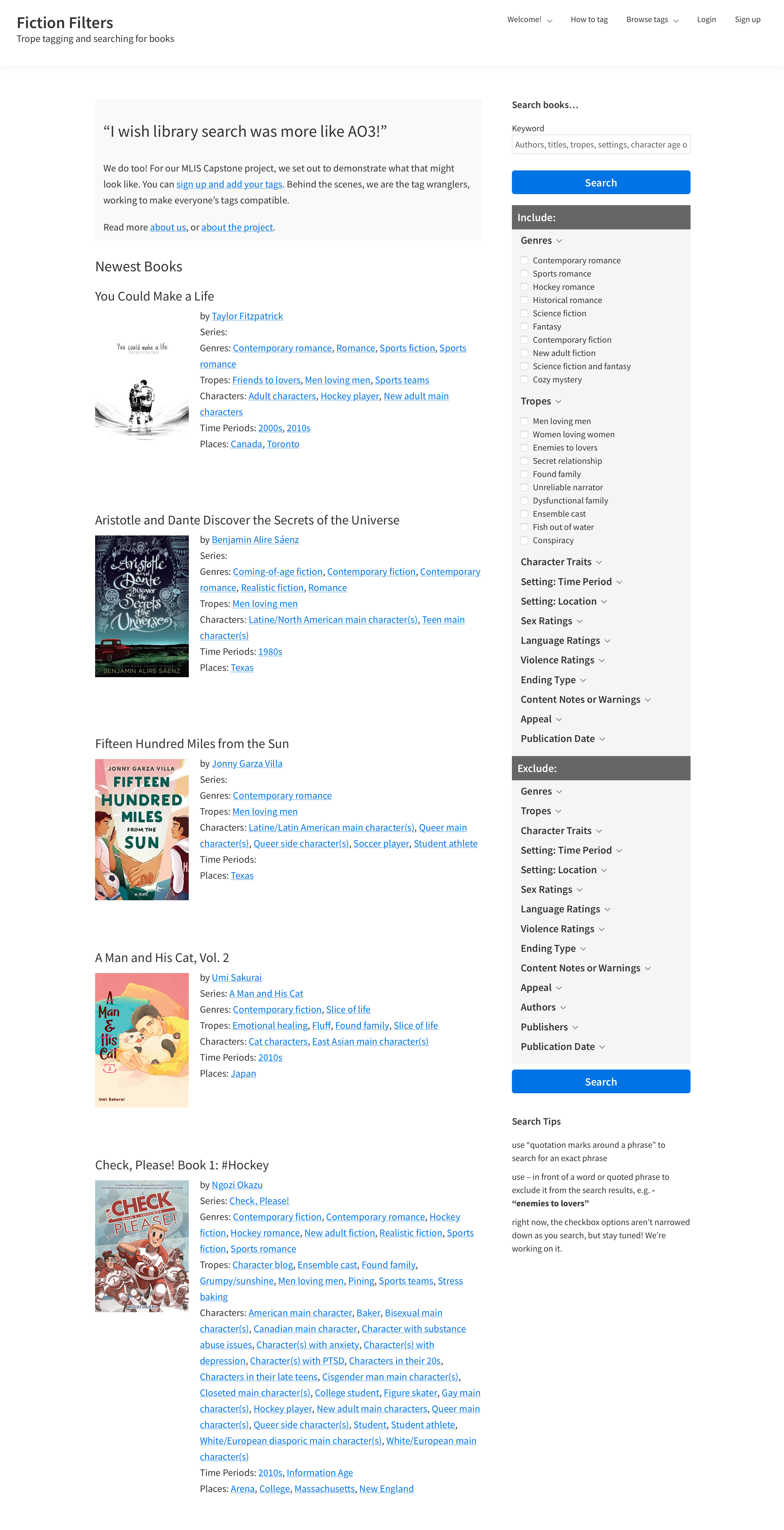 For my capstone team project, I built a crowdsourced tagging site for novels. Using a tag wrangling process and dual include/exclude search interface inspired by the Archive of Our Own, we demonstrated how curating user-submitted tags into a detailed controlled vocabulary could improve library metadata, search, and discovery for fiction. This workflow could be applied to any domain where it is difficult for catalogers to supply the metadata necessary to meet users’ search needs.
Read more at fictionfilters.org →
For my capstone team project, I built a crowdsourced tagging site for novels. Using a tag wrangling process and dual include/exclude search interface inspired by the Archive of Our Own, we demonstrated how curating user-submitted tags into a detailed controlled vocabulary could improve library metadata, search, and discovery for fiction. This workflow could be applied to any domain where it is difficult for catalogers to supply the metadata necessary to meet users’ search needs.
Read more at fictionfilters.org →
Text Mining for Intertextual Relationships
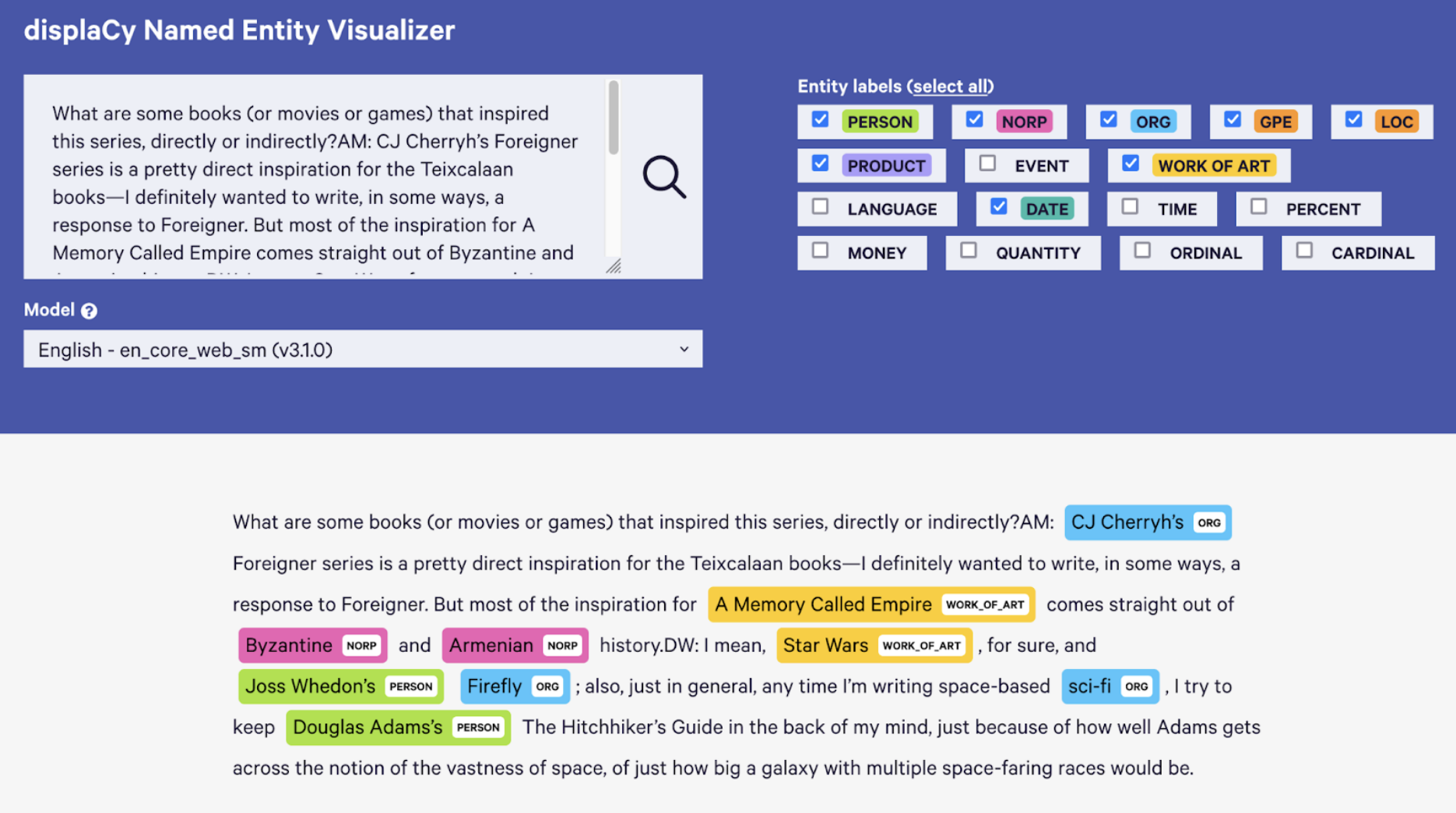 In early 2022, I did an independent study project to demonstrate how text mining methods could be used to glean bibliographic relationships from book reviews and author interviews. The ultimate goal would be to incorporate these relationships into catalog records so that searchers could trace links of inspiration and allusion in fiction in the same way they do citation chains in academic publications.
More on the text mining project→
In early 2022, I did an independent study project to demonstrate how text mining methods could be used to glean bibliographic relationships from book reviews and author interviews. The ultimate goal would be to incorporate these relationships into catalog records so that searchers could trace links of inspiration and allusion in fiction in the same way they do citation chains in academic publications.
More on the text mining project→
Patron Surveys: Finding LGBTQIA+ Materials
As a first year research methods project, in late 2019 my team surveyed library patrons to learn how they find materials on LGBTQIA+ topics, particularly fiction. We confirmed our hypothesis: they don’t. Everyone we surveyed came to the library to search for specific titles and authors based on lists they’d compiled using social reading sites, bookstore searches, and recommendations from friends. How users find LGBTQIA+ materials in libraries on YouTube → presentation PDFFiction Classification
For the seminar on classification theory in early 2021, I put together a sequence of three presentations on the Library of Congress Genre/Form Terms vocabulary, with a close look at the terms for literature. These contain some overlap to reestablish context, as they were given several weeks apart.- Introduction to LCGFT and the history of fiction classification schemes
- Detailed look at elements of taxonomy design in LCGFT
- Overview of LCGFT design, history, and my recommendations for future changes